
We are not simply gardening with a stopwatch anymore. We are building food systems. That means a lot and takes a bit of schooling. See, there comes a point in life when you realize you’ve been using the wrong word for the thing you’ve been doing.
For years, the polite word was “gardening.” That is what people call it when you put seeds in dirt, water them, wait on weather, and hope the deer, heat, bugs, drought, and government don’t get there first.
But “gardening” is not quite the word anymore. Around here, we are not guarding much of anything. We are not arranging petunias for visual therapy. We are not building a lifestyle backdrop for a seed catalog photo shoot.
We are working on food.
Calories. Nutrition. Reliability. Redundancy. Production. Storage. Water. Energy. Heat. Cooling. Growth rates. Yield per hour. Yield per gallon. Yield per square foot. Yield per watt.
That is a different domain entirely.
Which is why the project now has a better name:
Foodening.
The old One Hour a Day idea has not gone away. It has matured. One hour a day, properly aimed, is still one of the most powerful systems in human life. One hour a day will build a garden, a radio station, a book, a lawsuit, a business, a skill set, a pantry, or a body of knowledge if a person keeps at it long enough.
What has changed is the target.
The target is no longer “gardening.” The target is food, end to end.
That means seed selection, sprouting, soil, hydroponics, grow-room design, air movement, cooling, water quality, oxygenation, electrical environment, harvesting, storage, cooking, preservation, and the hard practical question of what actually puts useful nutrition on the table with the least dependency on fragile outside systems.
This is where the adult part of the conversation begins.
A lot of modern life has been engineered to make people helpless while calling it convenience. Food appears in stores as if by magic. Electricity appears at the wall. Water appears at the tap. Medicine appears in bottles. Software appears in the cloud. Money appears as numbers on a screen.
Until one day, some piece of the chain hiccups.
Then everyone remembers that civilization is not a product. It is a system.
Systems require inputs. Systems require maintenance. Systems fail when no one understands them anymore.
That is why The Foodening matters. It is not about becoming a hermit, a prepper caricature, or a backyard revolutionary wearing overalls and distrust. It is about recovering practical participation in the life-support systems that keep people alive.
Around here, that has kept us busy.
Two experimental tracks are now taking real time.
The Edible Scientist
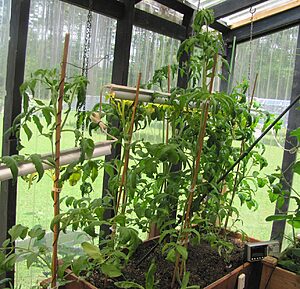
The first is electroculture. That word still carries a little circus dust on it because it has been overclaimed by hobbyists and under-studied by conventional agriculture. But the underlying premise is not crazy. Plants are electrochemical organisms. Roots move ions. Soil conductivity matters. Cell membranes depend on charge gradients. Lightning changes nitrogen chemistry. Atmospheric electrical conditions are part of the natural growing environment.
The rational question is not whether electricity and biology interact. They obviously do.
The rational question is whether a grower can apply controlled, modest, repeatable electrical conditions in a way that improves plant vigor, nutrient uptake, disease resistance, or yield.
That is where the work begins.
Not with magic antennas and miracle pumpkins, but with boring comparative testing. Same seeds. Same water. Same light. Same nutrients. One variable changed at a time where possible. Frequency, waveform, grounding method, electrode placement, day and night light timing, and plant response all become part of the experiment.
The point is not to prove a belief. The point is to find out whether there is a controllable effect worth building into a food system.
Even a modest effect could matter. A five or ten percent yield improvement, if real and repeatable, becomes significant when applied across beds, seasons, and years. In a future where input costs rise and supply chains wobble, small efficiencies compound.
OXY What?
The second experimental track may be more immediately practical: highly oxygenated water.
This one is less exotic and may prove more valuable.
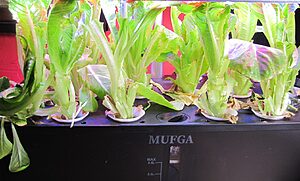
Roots need oxygen. Warm water holds less dissolved oxygen than cool water. Hydroponic systems, especially small warm reservoirs, can become oxygen-limited faster than people realize. When the root zone is under-oxygenated, plants do not merely “drink less.” The whole nutrient uptake and disease-resistance picture changes.
So the question becomes simple: What happens when we treat water not just as hydration, but as a carrier system for oxygen?
That leads to airstones, circulation, water temperature management, reservoir design, and possibly separate handling for different crops. Lettuce does not want the same thermal world as peppers. Tomatoes do not behave like bok choy. A grow room is not one environment. It is a collection of microclimates pretending to be one room.
Highly oxygenated water is therefore not a gadget trick. It is a systems question.
Can root health be improved? Can growth rate be improved? Can disease pressure be reduced? Can warm-weather hydroponics be made more forgiving in places like East Texas, where heat is not an inconvenience but an operating condition?
Those are worth testing.
And notice what happens when the two tracks are viewed together. Electroculture asks whether the electrical environment can be tuned. Oxygenated water asks whether the fluid environment can be tuned. The common theme is not gardening. It is controlled life-support engineering.
That is the pivot.
With Drought About…
That brings us to the bigger operating condition this year: drought, heat, and the need to make every gallon and every hour count.
Foodening is not a hobby name. It is a domain name in the deeper sense.
A domain is a way of organizing reality. Inside the gardening domain, people ask gardening questions. Inside the Foodening domain, people ask food-system questions.
National Media tend to follow the weekly Drought Monitor reports. But the NOAA Climate Prediction lab is much more on point if your “foodening” includes three-squares a day. If you are anywhere along the foodening continuum, it’s the look-ahead that matters. And it’s not pretty:
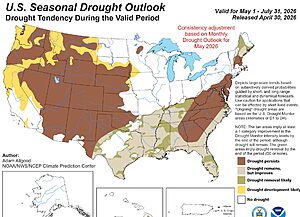
Not saying “Dust Bowl Conditions.” But do you hav e a systems-based threshold for N95 (or better) masking?
Gardening asks, “How do I grow this plant?” Foodening asks, “How do I produce reliable food under changing constraints?”
Gardening asks, “What variety looks good this year?” Foodening asks, “What provides calories, minerals, greens, protein, resilience, and storage value?”
Gardening asks, “How pretty is the bed?” Foodening asks, “What is the output per hour of human attention?”
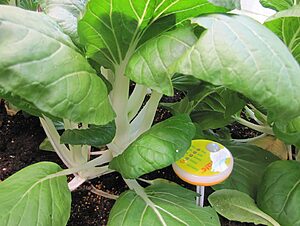
That last question matters because time is the one input most people cannot replace.
Which brings us back to One Hour a Day.
One focused hour a day is the natural unit for ordinary people building extraordinary resilience. It is enough time to start seeds, check water, harvest sprouts, clean filters, inspect plants, log results, repair irrigation, rotate stored food, sharpen tools, or build the next small piece of infrastructure.
It is not so much time that the project collapses under its own ambition. That may be the real secret. Most people fail at resilience because they try to convert their whole life at once. They get religion on a Saturday, buy too much equipment by Sunday, exhaust themselves by Wednesday, and by the next month the whole thing is another abandoned good intention in the garage.
One hour a day avoids that trap. Here are a couple of views of where One Hour A Day has gotten us this year: It has turned resilience into a pulse.
Food systems like rhythm. So do people. So do websites, as it turns out. Miss the pulse long enough and the system forgets you are alive. Keep the pulse going and the system begins to organize around you. We are adding both RSS and Feed links to the menu – so please add for updates as they come.
That is why Foodening will likely become more visible here. Not as a commercial hustle. Not as another “brand.” Heaven knows the world has enough brands pretending to be movements. This is more like a notebook from a working life-pod.
A sustainable life-pod is not a bunker. It is not a fantasy of sealed-off independence. It is a practical household-scale system that improves the odds. It produces some food, stores some water, buffers some energy, preserves some knowledge, and reduces helplessness.
It may have solar panels, water storage, sprouts, hydroponics, raised beds, backup heat, evaporative cooling, seed banks, pressure pumps, and a few old tools that still work when the app store doesn’t.
But its real output is not lettuce. Its real output is optionality. Which lives right next door to Sovereignty. And that matters.
That is what a lot of modern commercial life has quietly taken away. People have more choices on screens and fewer choices in reality. They can choose between fifty streaming shows but may not know how to produce a week’s worth of greens. They can compare mortgage rates instantly but may not be able to repair a water line. They can argue policy all day but cannot name what is growing in their own soil.
That is not progress. That is abstraction pretending to be power.
Foodening moves the other direction. It’s a domain that runs from the selection and planting of seeds, through watering, top-dressing, and then into cooking and storage. Out the composting toilet, though we may take a pass on that – too much to cover in between.
It says food is not merely a consumer category. Food is a living interface between land, water, sunlight, biology, technology, labor, and intelligence. It says the household is not merely a consumption unit. It can also be a production node.
Foodening says resilience is not paranoia. It is good engineering. And it says one hour a day, properly spent, can change the practical future of a household.
With modern methods and a still-working supply chain? Hour a Day is too much. But Foodening takes longer. So yes, the language is changing.
Less gardening. More Foodening.
Less decorative thinking. More calories, systems, yield, nutrition, water, oxygen, energy, and continuity. Plus a side order of time accounting.
Less commercialism.
More sustainable life-pods.
Because in the end, we do not eat ideology. We do not eat market commentary. We do not eat cloud software, campaign slogans, or central-bank jawboning.
Food, like civilization, has to come from somewhere.
Write when you get thyme,
George